
Databricks done with engineering discipline.
Zenithive provides Databricks consulting services for Lakehouse implementation, Mosaic AI rollouts, Unity Catalog governance, and MLOps. Delivered by senior data engineering pods that ship production pipelines, not slide decks.
98%
Platform uptime
<14d
Pod onboarding
1:1
Named ownership
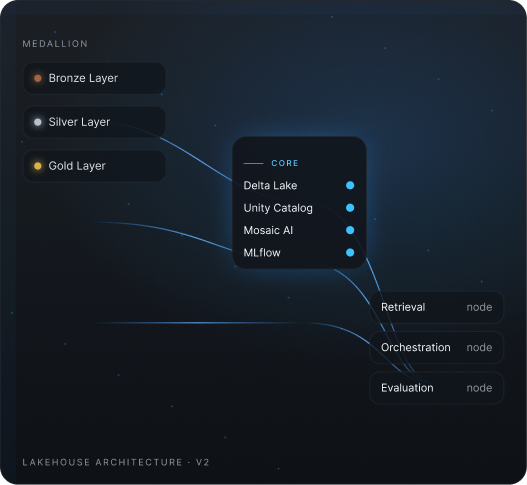
A complete databricks practice.
Databricks succeeds when architecture, governance, AI, and operations evolve together. Our Engineering Pods own the platform end-to-end, from implementation through production scale.
01
Lakehouse Architecture
Design and implement Databricks Lakehouse platforms with Delta Lake, medallion architectures, Delta Live Tables, and production-grade data engineering foundations.
02
AI & ML platforms
Build Mosaic AI, Vector Search, MLflow, model serving, and MLOps workflows that move beyond notebooks into production environments.
03
Governance & control
Establish Unity Catalog governance, lineage, permissions, and operating standards that keep data, AI, and teams aligned as adoption grows.
04
Migration & modernization
Migrate Hadoop, Spark, and legacy analytics workloads to Databricks through phased delivery models designed to minimize operational risk.
How we engage on a Databricks build.
Our Pods work through a structured process designed to create long-term platform value, not just complete a project.
1
Workload and Cost Baseline
We map current workloads, current spend, and the business KPI tied to the target Databricks workload.
2
Architecture Design
Lakehouse topology, Unity Catalog metastore strategy, MLOps reference architecture, and the cost model.
3
Pod-Led Delivery
Dedicated data engineering pod. Senior Databricks engineers, named tech lead, named backup.
4
Operationalisation
Runbooks, cost dashboards, and the handover that lets your team operate the platform after we transition.
5
Cost & Performance Visibility
Implement cost dashboards, workload visibility, and platform monitoring so teams can manage performance and spend as adoption grows.
Three ways to engage our Databricks practice.
Whether you're evaluating Databricks, scaling a Lakehouse platform, or operationalizing AI workloads, our Pods align to the stage of your platform journey.
Assess · VALIDATE · PLAN
Databricks POC
Fixed-scope proof of concept designed to validate platform, architecture, or AI initiatives before larger investment decisions.
When to use
Evaluating Databricks adoption
Testing a Lakehouse architecture
Validating Mosaic AI use cases
Typical outcomes
Architecture recommendation
Platform roadmap
Go / no-go decision framework
Build · Operate · Scale
Dedicated Databricks Pod
A dedicated team of data engineers focused on Lakehouse delivery, AI workloads, governance, and long-term platform ownership.
When to use
Building production Lakehouse platforms
Scaling data and AI workloads
Establishing governance and MLOps
Typical outcomes
Production-ready data platform
Governance and operating standards
Predictable delivery cadence
Most chosen
AI · GOVERNANCE · MLOPS
Specialized Capability Pod
Focused engineering support for a specific Databricks capability, rollout, or modernization initiative.
When to use
Unity Catalog migrations
Mosaic AI implementation
MLOps maturity initiatives
Typical outcomes
Governance rollout
Production AI workflows
Accelerated capability adoption
Databricks vs other platforms
An honest comparison of where Databricks fits, where it wins, and where another platform may be the better choice.
Capability
Ownership
Cost visibility
Knowledge retention
Delivery rhythm
MLOps support
Governance
Databricks Pods
Named platform lead
DBU + delivery dashboard
ADRs + runbooks shipped
Two-week iterations
Mosaic + MLflow native
Unity Catalog policies-as-code
Traditional Consultancy
Account manager
Time & materials
Tribal, vendor-locked
Statement of work
Add-on practice
Manual setup
Grow your databricks platform at your pace.
Most successful Databricks implementations are built in stages. Start by establishing the foundation, scale through a dedicated platform team, then extend into AI, MLOps, and advanced analytics as the platform matures.
From first ingest to enterprise-scale governance.
SMEs
Establish a Lakehouse foundation from day one
Define data products, ownership, and governance early
Build AI-ready architecture without overengineering
Legacy DW → Bronze
Bronze → Silver
Silver → Gold + BI
For SMEs
Migrate legacy data warehouses and ETL workloads
Roll out Unity Catalog across teams and business units
Enable self-service analytics with governance guardrails
Stabilizing delivery
Reducing tech debt
Improving predictability
For Enterprises
Govern data, AI, and analytics across multiple domains
Standardize access, lineage, and policy enforcement
Scale Lakehouse operations across regions and business units
Risk-aware execution
Parallel modernization
Governance-friendly delivery
Proven foundations. AI-ready platforms.
Opinionated Choices
A battle-tested Databricks foundation built around governance, reliability, and long-term platform scalability.
Reference stack
Storage
Delta Lake
Catalog
Unity Catalog
Compute
Spark / Photon
Orchestration
Workflows / Airflow
Modeling
dbt
Quality
Expectations
AI-native delivery
Production-ready AI workflows built directly into the Databricks platform, not bolted on later.
AI execution flow
live
Retrieve
Augment
Generate
Evaluate
Products We’ve Accelerated.



Why teams choose Zenithive for Databricks.
Ownership
HA named platform lead, accountablefor outcomes. eading
One person owns architecture, cost and reliability — and stays with you across quarters.

Cost discipline
DBU budgets, cluster policies, real dashboards.
DBU / day
−22%
Knowledge
ADRs, runbooks, pairing.
Your team owns the lakehouse — not the vendor.
MLOps + GenAI
Mosaic AI, MLflow, eval harnesses.
Continuity
Same pod, every quarter.
Operating rhythm, not a revolving door of
contractors.
Frequently Asked Questions
What does a Databricks consulting engagement cost?
A Databricks POC at Zenithive ranges from $40K to $110K depending on workload complexity. A full Lakehouse or Mosaic AI implementation typically runs $150K to $400K over the first quarter. A dedicated pod engagement runs $35K to $55K per month per pod.
Do you do Hadoop to Databricks migrations?
Yes. We migrate Hadoop, on-prem Spark, and Hive workloads to Databricks Lakehouse. Most migrations run as workload-by-workload moves rather than platform-by-platform cutovers. Typical timeline: 4 to 9 months for a meaningful workload.
Do you work with Mosaic AI?
Yes. Mosaic AI Agent Framework, Mosaic AI Gateway, Vector Search, and the RAG patterns that work in production. We have shipped genAI on Databricks for clients in financial services, healthcare, and retail.
Can you fix a Unity Catalog rollout that is already in trouble?
Yes. Most of our Unity Catalog work is corrective. We rebuild the metastore topology, remap external locations, and stage the cutover so the existing workloads keep running.
Are you a Databricks Partner?
We work as a Databricks consulting partner. The partner designation matters less than the engineering depth on the pod, which is what we ask you to evaluate us on.
Tell us where the Lakehouse hurts. We'll come back with a practical next step.
Brief us on the platform, product, or delivery outcome you need. A fintech engineering lead will reply within one business day with a Pod composition recommendation and a 30-minute slot to walk through it.
Build A Lakehouse That Scales.
Govern data, analytics, and AI on a single foundation without losing visibility, control, or delivery momentum. Databricks is designed to unify data engineering, governance, analytics, and AI workloads on one platform.